Educational case study based on a fictional university scenario. The requirements summary is separate from the original solution. The supplied solution wording, tables, chart and references are retained; one reference to the University of Birmingham in section 3.1 appears in the original report, although the scenario concerns the fictional University of Belmont.
Assessment requirements
- Organisational structure and IT governance: prepare an organisational chart, recommend the governance committee and member roles, and relate two governance activities to the COBIT EDM processes.
- Applications portfolio management: use Gartner's TIME strategies to classify four applications and justify each choice with stated assumptions.
- IT service delivery and SLAs: recommend an onshore or offshore outsourcing arrangement with supporting references, prepare a service level agreement and explain three approaches to improving the university's negotiating position.
- IT organisational arrangement: explain, using research, the advantages of separating business-as-usual operations from new IT initiatives, including digital transformation.
Introduction
The University of Belmont (UoB) is an Australian medium-sized university with its activities such as education, research, and administration relying on different types of information systems. The Digital Services Division of UoB is responsible for managing central infrastructure, corporate applications, security, and user support. However, from the given case, it can be seen that the descriptions of services and service level agreements are inadequate; at the same time, the university plans to outsource certain IT processes. This report discusses governance, application portfolio management, outsourcing, and service level agreement design, and an organizational approach capable of ensuring both operational stability and digital innovation.
1. Organizational Structure and IT Governance
1.1 Proposed organisational chart
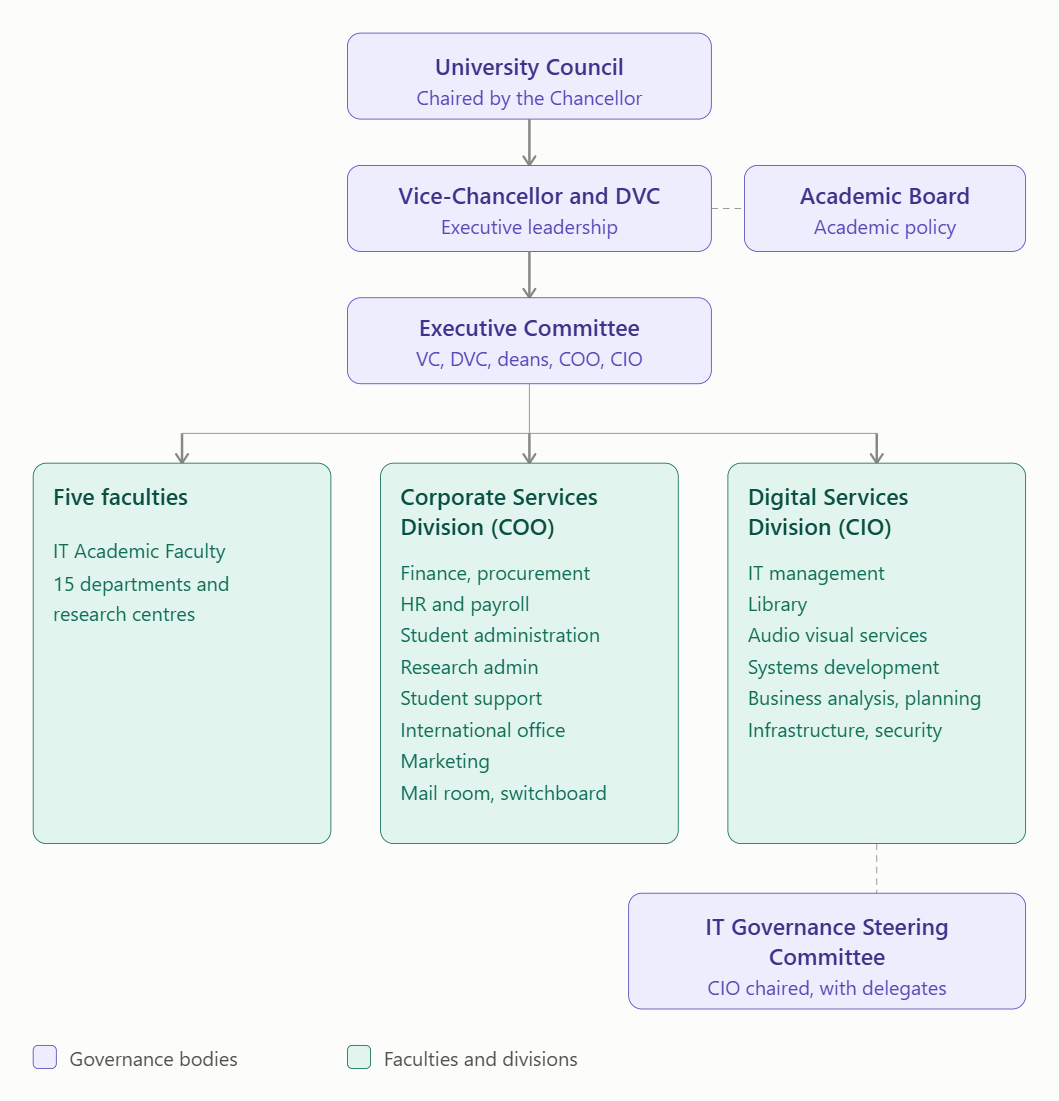
Below is a chart showing the bodies and units listed in the case:
1.2 Recommended IT governance committee
The UoB needs to maintain and enhance the IT Governance Steering Committee with a documented charter, delineated decision-making powers, and a reporting structure to the Executive Committee and the Council (ISACA, 2018). This ensures that no duplicate entity is created.
| Member | Suggested role | Main responsibility |
|---|---|---|
| CIO | Governance lead | Set agenda, coordinate decisions, monitor technology risk and report to executives. |
| COO | Business operations representative | Connect IT decisions with finance, HR, student administration and service continuity. |
| Faculty dean | Academic business representative | Represent teaching, research and faculty priorities. |
| IT Academic Faculty representative | Technical and specialist user voice | Advise on teaching labs, specialist systems and research computing needs. |
| Information security | Risk adviser | Assess cyber security, privacy, access control, and incident readiness and compliance risks. |
| Finance representative | Commercial oversight | Review business cases, whole-of-life costs, and procurement and outsourcing terms. |
| Enterprise architecture | Portfolio adviser | Assess integration, technical debt, standards and application lifecycle choices. |
| Student or staff service representative | End-user perspective | Bring forward usability, accessibility and service-impact concerns. |
1.3 Governance activities and COBIT EDM processes
- Evaluation and prioritisation of IT investment opportunities, including the outsourcing proposition, cyber security enhancements and AI-powered capabilities. The committee needs to compare potential benefits, costs, risks, fit with the overall strategy of the institution and implications for teaching and research. COBIT EDM02 (Ensure Benefits Delivery) assists in making sure that technology investments deliver measurable value, and EDM04 (Ensure Resource Optimisation) – in effective utilisation of resources, people, budgeting, infrastructure and vendor capabilities (ISACA, 2018).
- Management and monitoring of IT risk, service delivery performance and compliance. The committee is to assess security events, availability of services, performance of suppliers, risks related to data protection and achievements of agreed goals. EDM03 (Ensure Risk Optimisation) assists in the governance of risks related to technology, and EDM05 (Ensure Stakeholder Engagement) – in effective communications with faculties, administrative departments and other relevant parties. EDM01 (Ensure Governance Framework Setting and Maintenance) is the underlying process in defining responsibilities, decision-making rights and governance framework (ISACA, 2018).
Both of these activities represent governance practices where the committee determines directions, evaluates proposals and monitors results, and operational managers implement decisions.
2. Applications Portfolio Management
The TIME framework from Gartner categorizes applications based on the value of the application and its technical state (Duggan, 2010). Applications that still have value and the problems can be handled are categorized under “Tolerate”. Applications with high value that need improvement would fall under “Invest” category while applications that are valuable but need migration to a new platform belong to the “Migrate” category. Lastly, applications with reduced value are best eliminated.
| TIME strategy | Application | Assumed situation | Rationale |
|---|---|---|---|
| Tolerate | Legacy campus parking permit tool | Used by a small group, stable, low cost, limited integration needs; replacement offers little immediate benefit. | Keep it operating with basic support and security patches. Review annually and avoid major new features. |
| Invest | Student records system | Core system with high business value and substantial impact on enrolment, progression and reporting. | Prioritise resilience, access controls and data quality. Track uptime, incidents and user satisfaction. |
| Migrate | Legacy in-house research administration database | Assumed to be built in a procedural language with siloed data and growing maintenance problems, but still supports important research workflows. | Map data and processes, clean and validate records, then move to a supported platform with tested interfaces and a staged cutover. |
| Eliminate | Duplicate departmental room-booking spreadsheet application | Assumed to duplicate the central timetabling system, have low usage and no unique control or reporting need. | Confirm user and record requirements, export required records, communicate the retirement date and remove access safely. |
Prior to the validation of the matrix, UoB should rate each application on its criticality to the business, number of users, yearly cost of operation, vendor support, exposure to security threats, technical state, data sensitivity, and integration difficulty. Furthermore, the portfolio manager should determine the system owner and document the dependencies so that the retirement of one application would not affect the other.
3. IT Services Delivery and Service Level Agreements
3.1 Outsourcing recommendation: onshore service desk
If the University of Birmingham decides to outsource its IT service desk, it should begin with an onshore IT service desk that is based within Australia, or a company that offers comparable onshore services. It is important to remember that this service is high contact and used by students and faculty. Also, this service desk might have access to sensitive data during troubleshooting of accounts, devices, and access issues (Australian Cyber Security Centre [ACSC], 2021). Onshore service desks will provide more convenience when it comes to dealing with time zones, escalation of issues to campus employees, communication with users from the university, and contract compliance.
The basis for this decision needs to be the total cost and risk assessment that is properly documented and cannot solely be based on labour rates. The UoB must consider data location and availability, subcontracting, staff vetting, incident reporting, continuity of service, languages and accessibility, service times, transition cost, and the provider’s ability to handle university academic peaks. UoB must get legal and procurement advice regarding Australian privacy and record requirements before the transfer of any private or confidential data (Office of the Australian Information Commissioner [OAIC], 2026).
Australian Government’s ISM for security controls (Australian Signals Directorate, 2026); OAIC guide on Australian Privacy Principles especially on APP 8 – cross-border disclosure (OAIC, 2026); ACSC guide on securing engagement with managed service providers (ACSC, 2017, 2021); ISO/IEC 20000-1:2018 on service management systems (ISO/IEC, 2018); ITIL 4 on service desk and service-level management (AXELOS, 2019). These materials can provide the criteria for both controls and service management, but still cannot guarantee that any onshore service provider is better than offshore one. UoB should benchmark the submitted proposals against the same criteria.
3.2 Service Level Agreement (SLA)
3.2.1. Service Description and Scope
Scope of Service Desk: The provider shall receive, record, categorize, prioritize, and resolve eligible first-level incidents and service requests using the agreed portal, email, and telephone channels. The provider will provide end-user communication, first-level diagnosis, approved knowledge-base advice, and escalate to UoB or to specialized vendors if necessary. System changes, privileged access, and security-related tasks shall follow UoB-approved processes.
3.3.2. Performance Metrics and Service Levels
Service Desk Hours and Availability: The Service Desk shall be operational from 08:00 to 18:00 Australian Eastern Time on UoB business days except on the agreed university holidays. An incident reporting channel shall be available 24/7 and an on-call escalation process shall be followed for reporting any critical incidents. Planned maintenance and channel unavailability should be informed at least five working days prior.
Priority and Response Targets:
- P1 (critical: widespread failure or security/teaching implications): acknowledged within 15 minutes during covered hours; inform UoB’s duty contact point immediately and update every 30 minutes.
- P2 (high: significant service impaired for a cohort): acknowledged within 30 minutes and updated hourly.
- P3 (normal: individual customer or workaround available): acknowledged within four business hours and daily until solved if outstanding.
- P4 (request/minor): acknowledged within one business day with an estimated date for fulfillment. Proposed target only, subject to agreement following baseline analysis (AXELOS, 2019).
Resolution and Escalation: Resolution times are dependent on priority level, dependencies, and which party is responsible for the affected service provider or UoB. Provider will set initial target for restoration or workaround as follows: P1 – four hours, P2 – one business day, and P3 – five business days, as technologically possible. When any target is in jeopardy, provider must escalate to nominated UoB service owner prior to target expiration. Acknowledgment, restoration and resolution are separately measured.
Security, Privacy and Ticketing: The Service Provider is to authenticate the user prior to taking any account actions, implement least privilege access control, maintain an audit log of all tickets generated, ensure encrypted transmission of data, and not to disseminate or transfer UoB Data or Tickets to a third party without prior written authorization by UoB. Security or Privacy Breach is to be reported to UoB within an hour of discovery. UoB owns its Data and Ticket History.
Reporting and Governance: The provider will provide statistics of ticket volumes, distribution of tickets according to their priority levels, response and resolution performance statistics, age of backlog tickets, tickets that were re-opened, customer satisfaction statistics, and statistics on escalations and security breaches on the first business day of every month. The provider will attend monthly operational review meetings and quarterly service reviews. Failure to comply results in corrective action plan and possible service credits or termination of services as stated in the final agreement.
3.3.3. Responsibilities:
UoB will supply detailed service specifications, named escalations contacts, timely approval and access to the relevant internal teams. The service provider will keep trained staff, up-to-date procedures and an effective continuity plan in place. Exceptions apply only for times when there is clear evidence that the delay was due to UoB or an approved third party, and these need to be documented with the reason and evidence.
The final SLA will define the business calendar, severity levels, the calculation of service credit, data storage, audit rights, termination assistance and escalation process (Goo et al., 2009).
3.3 Three ways to strengthen UoB’s negotiating position
- Set up a dependable baseline and services catalog: Determine existing tickets volume, category, time of peak activity, resolution time, recurring incidents, customer satisfaction and cost-per-service delivery. Clearly define the scope of services. Factual baseline will prevent the suppliers from creating fuzzy goals or pricing an ambiguous service. Moreover, it will be useful for UoB as a basis for determining realistic performance benchmarks.
- Get the independent specialized opinion and analyze the market: Utilize procurement, legal, security and service management experts for review of RFP, draft SLA and contract. Compare several offers according to unified criteria concerning service, security, transition and total life-cycle costs. Independent expert opinion helps to decrease the problem of informational asymmetry and allows UoB to identify hidden fees, inadequate remedies and imbalanced contract terms.
- Develop requirements, risk control measures and exit strategies prior to tendering: Define deliverables, data management procedures, audit clauses, sub-contracting consent, incident reports, business continuity, knowledge transfer and help with exiting (Goo et al., 2009). Have a viable alternative through evaluation of at least two suppliers and keeping adequate internal capacity to manage the contract.
4. IT Organisational Arrangement
4.1. BAU and New IT Initiatives
There is a separation of system development from systems administration in this case where the two groups report to different managers. Such a separation can lead to handover issues whereby the developers would try to optimize for delivering the functionality while the operations team would be concerned about stability. In the BAU versus change model, the classification of work is done based on the objective whereby one stream would ensure the protection and improvement of the stable services while the other would deliver the innovation capabilities and transformation (Gartner, 2014; Horlach et al., 2017).
Business-as-usual (BAU) activities
For the BAU stream, this would involve taking ownership for service desk operations, reliability of infrastructure, monitoring, incidents, problems, standard changes, patching, back-ups, access administration, continuity and suppliers' performance. This will be measured by availability, reoccurrence of incident, time taken to recover, backlog, security control compliance and user experience. Standardized processes and clear ownership would assist in protecting key services such as student records, finance, HR and learning management (Gartner, 2014).
New IT projects and digital transformation
This would include new systems, system modernization, integration of data, automation, AI proof-of-concept projects and improvement of teaching, learning, research and administration. Multidisciplinary teams including business owner, technical, data, security/privacy advisors and impacted users would be used. The projects must define their deliverables, conduct small experiments when required, conduct architecture/security review and identify benefits before wide implementation (Horlach et al., 2017).
4.2. Why this arrangement is better?
This creates clear priorities where operational teams will be responsible for ensuring stable operations, whereas transformation teams will be responsible for proven benefits of changes. Next, it decreases the probability that urgent tasks of support keep displacing innovation tasks, and at the same time decreases the probability that innovations will not take into account operational support needs. In addition, this could make the adoption of modern technologies less risky through inclusion of security, privacy and data management controls within projects.
Independent streams will replicate the same silos that UoB is trying to avoid (Horlach, Drews & Schirmer, 2016). Furthermore, an innovation team could develop services that are not sustainable within BAU. Therefore, UoB should create common standards around architecture, common planning, service transition gates, retrospective meetings across teams and a common prioritized portfolio. Each new service should have an identified operational owner, budget allocation, run book, monitoring system, security review and agreed service level objectives prior to going live.
When adopting disruptive technologies such as artificial intelligence, UoB should have a business purpose and use case, transparent and lawful use of data, human oversight where the decision has significant consequences, check for biases and inaccuracies, and an approach to monitor the performance of the model after its deployment. Pilot projects can be done without committing sensitive data and processes to the tool.
Conclusion
UoB’s centralized DSD provides a foundation for the consistency of service delivery, but the case study highlights the deficiencies in the area of formal service definition, cost transparency, and service-level agreements. A well-represented governance committee will assist in better-informed decision making, risk management and improved relationship management. The use of the periodically updated TIME matrix could be effective in allocating funds to beneficial IT assets and minimizing unnecessary legacy risks. In the context of planned outsourcing, it is important for UoB to determine service objectives, evaluate suppliers in terms of total value and risk, and secure proper security, escalation and exit arrangements. Finally, organizing activities based on BAU services and new initiatives could be useful, given that both types of activity utilize the same approaches.
References
Australian Cyber Security Centre. (2017). Questions to ask managed service providers. Australian Signals Directorate. https://www.cyber.gov.au/
Australian Cyber Security Centre. (2021). How to manage your security when engaging a managed service provider. Australian Signals Directorate. https://www.cyber.gov.au/
Australian Signals Directorate. (2026). Information security manual (ISM). Australian Government. https://www.cyber.gov.au/ism
AXELOS. (2019). ITIL foundation: ITIL 4 edition. TSO (The Stationery Office).
Duggan, J. (2010). Application portfolio triage: TIME for APM [Research note]. Gartner.
Gartner. (2014). Bimodal IT [Research note]. Gartner, Inc.
Goo, J., Kishore, R., Rao, H. R., & Nam, K. (2009). The role of service level agreements in relational management of information technology outsourcing: An empirical study. MIS Quarterly, 33(1), 119–146.
Horlach, B., Drews, P., & Schirmer, I. (2016). Bimodal IT: Business-IT alignment in the age of digital transformation. In Multikonferenz Wirtschaftsinformatik (MKWI) 2016. Ilmenau, Germany.
Horlach, B., Drews, P., Schirmer, I., & Böhmann, T. (2017). Increasing the agility of IT delivery: Five types of bimodal IT organization. In Proceedings of the 50th Hawaii International Conference on System Sciences (HICSS 2017). https://doi.org/10.24251/HICSS.2017.656
ISACA. (2018). COBIT 2019 framework: Governance and management objectives. ISACA.
ISO/IEC. (2018). ISO/IEC 20000-1:2018 Information technology — Service management — Part 1: Service management system requirements. International Organization for Standardization.
Office of the Australian Information Commissioner. (2026). Australian Privacy Principles guidelines. https://www.oaic.gov.au/
Tushman, M. L., & O’Reilly, C. A. (1996). Ambidextrous organizations: Managing evolutionary and revolutionary change. California Management Review, 38(4). https://doi.org/10.2307/41165852