Educational case study based on the supplied CSCI369 Ethical Hacking assignment and solution files. Requirements are summarized separately; solution excerpts preserve the original wording. Personal identifiers, operational attack instructions and executable files are excluded. Lab screenshots are cropped to show selected evidence.
Assignment overview
The assessment consists of five tasks, worth 100 marks in total. It requires question-specific folders, written explanations, screenshots of results and, where applicable, Python programs. The specified environment includes Kali, Ubuntu and Metasploitable2 virtual machines.
Q1 — ARP Spoofer
Requirements summary
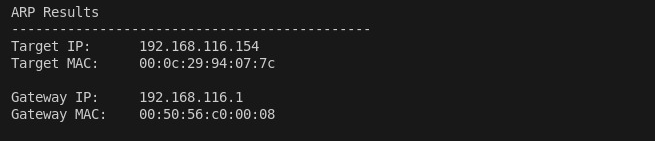
The first exercise assesses ARP spoofing concepts using Python and Scapy in an isolated virtual network, with written documentation and evidence of the lab result.
Original solution excerpt
This program demonstrates ARP spoofing (ARP poisoning) using Python and Scapy in a controlled network environment.
Q2 — ARP Scanner and Spoofing Detection
Requirements summary
The second exercise requires an independent defensive monitor that detects changes in IP-to-MAC mappings, identifies the active network interface, and limits collection to ARP traffic.
Original solution excerpt
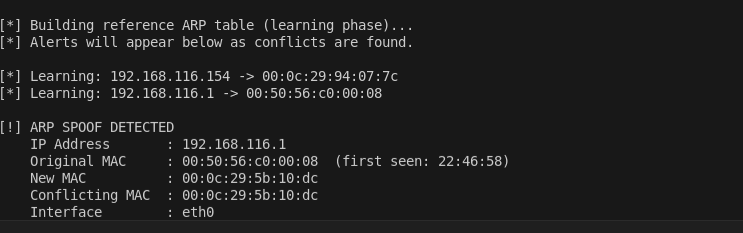
This program is an ARP spoofing detector that monitors live ARP traffic using Scapy.
It captures ARP reply packets from the network.
It builds a reference table of IP → MAC mappings.
If the same IP address later appears with a different MAC address, it generates an ARP SPOOF DETECTED alert.
It automatically identifies the active network interface.
The detector continuously monitors traffic until Ctrl+C is pressed.
Expected Result: Legitimate mappings are shown as Learning, while a conflicting IP-to-MAC mapping generates an alert containing the original MAC, new MAC, interface, and timestamp.
Q3 — Reverse Shell Concepts
Requirements summary
The third exercise examines client/server communication and remote command execution in an isolated Kali virtual-machine lab.
Original solution excerpt
This program is a TCP command server/listener that communicates with a remote client using Python sockets.
It receives and displays the command output returned by the client.
It handles connection errors and keyboard interruption (Ctrl+C).
This program is a TCP command-execution client that communicates with a remote server using Python sockets.
It includes error handling for invalid JSON, connection errors, and command timeouts.

Q4 — Hybrid Encryption and Authorized Recovery
Requirements summary
The fourth exercise studies hybrid encryption and authorized file recovery through a controlled ransomware simulation.
Original solution excerpt
This program demonstrates a hybrid encryption and authorized recovery concept using AES and RSA.
Expected Result: The original file is encrypted, its AES key is protected with RSA, and the authorized recovery process successfully decrypts the file.

Q5 — Gift Voucher Code Security
Requirements summary
The final CTF-style report examines a deliberately vulnerable UDP voucher service and the security weaknesses of MD5-based voucher generation. The brief calls for a written account of the findings.
Original solution excerpt
Target algorithm is MD5.
The original report contains identifying information and operational voucher-cracking details, which are excluded from this public version.